
360 Rolling Car Maintenance Schedule: Daily to Yearly Checklist
A printable maintenance schedule for joystick-controlled rolling car rides — daily pre-opening checks, weekly service, monthly battery testing, quarterly and yearly deep service, plus the log that keeps a warranty valid.
- 360 Rolling Car Maintenance Schedule: Daily to Yearly Checklist
- Why a schedule beats reactive repair
- Before opening: the 15-minute daily check
- Weekly: the 45-minute service
- Monthly: the service that prevents most downtime
- Electrical and control system
- Drive and transmission
- Battery capacity test
- Structure and restraint system
- Quarterly and yearly: the deeper service
- What to write down
- When to stop fixing and call the manufacturer
- Frequently asked questions
- How often should a rolling car be serviced?
- How long should a full charge last on a 360 Rolling Car?
- Can our own staff do the monthly service?
- What spare parts should we keep on site?
- Does maintenance affect the warranty?
- Build the schedule once, then run it
360 Rolling Car Maintenance Schedule: Daily to Yearly Checklist
A rolling car does not fail suddenly. It fails on a schedule you ignored for six months — a joystick that drifts a few degrees, a battery that no longer holds a full shift, a bearing that starts to sing. Operators who run these rides profitably are not the ones who fix fastest; they are the ones who inspect on a fixed cadence and never let a small fault become a closed attraction.
This guide gives you a maintenance schedule you can print and pin in the control booth: what to check before you open, what to check weekly, and what belongs in the monthly and yearly service. It is written for the Marwey 360 Rolling Car, the 180 Happy Rolling Car and the 360 Rolling Hamster Ball, but the logic applies to any joystick-controlled ride.
Why a schedule beats reactive repair
Every ride has three cost layers: the part, the labour, and the lost ticket revenue while the ride sits idle. Reactive maintenance only ever addresses the first two. A joystick replaced after it fails costs a part and an hour of labour; the same joystick replaced during a scheduled monthly service costs the same part and no lost revenue at all.
The second reason is safety documentation. If an incident ever reaches an insurer, a regulator or a venue landlord, the first question is always the same: show me your inspection records. A ride with a signed daily log is a very different conversation from a ride with nothing.
Before opening: the 15-minute daily check
This is the check the operator on shift performs, not a technician. It should take under fifteen minutes and it should be signed every single day.
| Item | What good looks like | Stop the ride if… |
|---|---|---|
| Battery charge level | Charged at the end of the previous shift, indicator in the normal band | Charge is below the level you need for a full session |
| Joystick response | Smooth in all directions, returns to centre without sticking | Any dead zone, drift, or delayed response |
| Rotation and motion | Free movement, no grinding, no metallic click | New noise, vibration, or a change in spin speed |
| Body panels and seat | Fasteners tight, no cracks, edges not sharp | Any loose panel or exposed edge |
| Safety belt / restraint | Latches cleanly, no fraying, spring returns | Buckle does not click or releases under load |
| Tyres / rollers / floor contact | Even wear, no flat spots, no debris wrapped around an axle | Visible flat spot or foreign object |
| Emergency stop | Cuts motion immediately, every time | Any delay at all |
| Surrounding floor area | Dry, clear, barriers intact, no trip hazards | Wet floor or a gap in the barrier |
The daily check is a go / no-go gate. It is not a repair session. If something fails, the ride does not open until it is fixed — that rule is what keeps the schedule honest.
Weekly: the 45-minute service
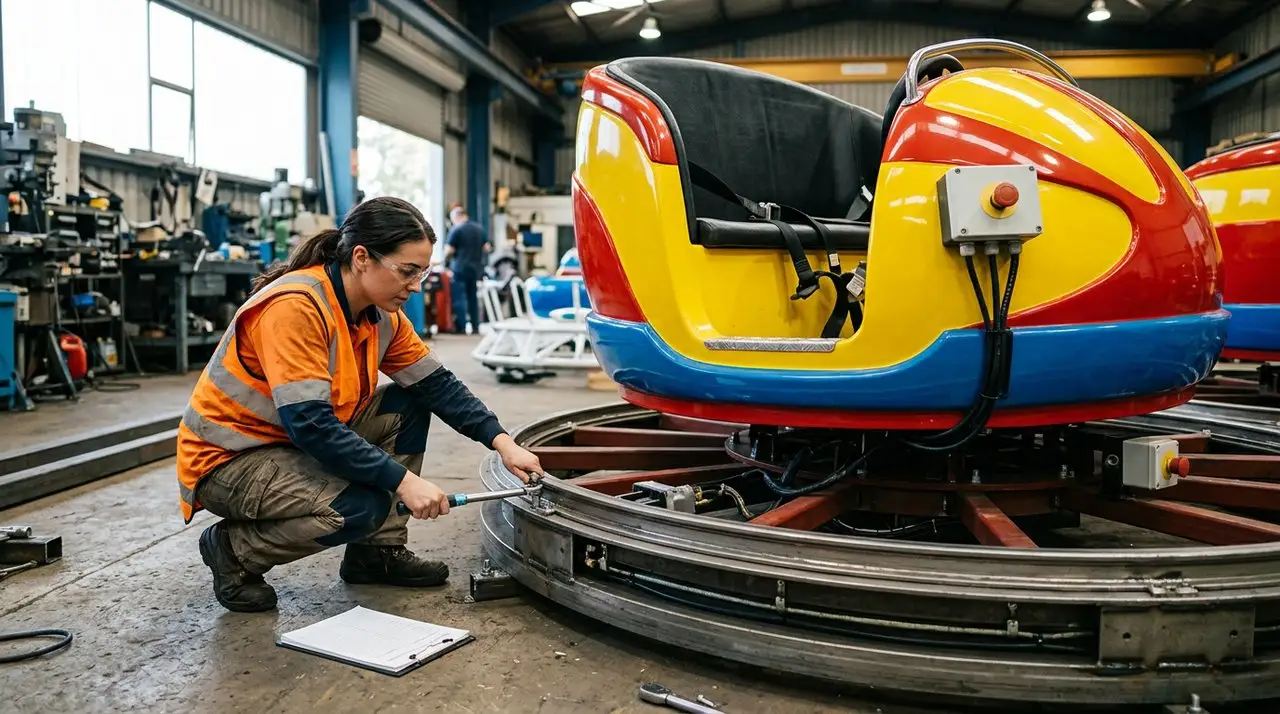
Weekly service is where you catch wear before it becomes a fault. It needs a technician or a trained senior operator, and it should be done on a day the ride is closed or during a quiet hour.
- Joystick calibration. Run the full range of motion and confirm the ride returns to a neutral position. A joystick that needs repeated correction is on its way out — put a replacement on order rather than waiting for a failure mid-session.
- Fastener torque check. Walk the frame and check the seat, panel and axle fasteners. Vibration is the enemy of anything threaded; a rolling car vibrates constantly.
- Battery terminals and cabling. Look for corrosion, loose lugs and heat marks. Clean terminals and re-tighten. On a 48V pack, a loose terminal is a heat source, not just a performance issue.
- Charger and charging port. Confirm the charger cuts off correctly and the port is not loose. Charging faults are the most common cause of "the ride only lasted three hours today".
- Moving parts lubrication. Follow the lubrication points in your manual. Over-greasing attracts dust, so apply the specified amount, not more.
- Clean the ride. Body, seat, handles and controls. Cleaning is also an inspection — you find cracks with a cloth in your hand that you miss from a distance.
Monthly: the service that prevents most downtime
Monthly service is where a rolling car either earns its reputation or starts costing you money. Book two to three hours and treat it as production time, not spare time.
Electrical and control system
Inspect the control board enclosure for moisture and dust, check connector seating, and confirm the emergency stop circuit is independent and functioning. Test the ride through a full motion cycle and listen — a change in sound is often the earliest electrical warning you get.
Drive and transmission
Check motor mounting bolts, belt or gear condition, and shaft play. On a 300W drive unit, play in the shaft shows up first as a slight lag between joystick input and motion.
Battery capacity test
This is the single most useful monthly measurement. Run the ride on a known charge and record the working hours achieved. Our 360 Rolling Car and 180 Happy Rolling Car are rated at 5–8 working hours per full charge; when a unit consistently lands at the low end of that band while the others do not, the pack is ageing. Track it monthly and you will replace batteries on your own terms instead of on a Saturday afternoon.
Structure and restraint system
Inspect welds, panel mounts, seat mounting and the restraint mechanism. Check that the restraint still fits the smallest and largest rider you admit. If your rider profile has changed — more adults, more group bookings — re-check the fit rather than assuming last year's setting is still right.
Quarterly and yearly: the deeper service
Quarterly, bring in a qualified technician for a full electrical inspection, bearing inspection on rotating assemblies, and a structural review of the frame and base. This is also the right moment to review your incident log and spare parts consumption — the two data sets that tell you what to stock.
Yearly, plan a full strip-down service: replace worn bearings, inspect and replace aging wiring, re-certify the restraint system, and re-verify the ride against the standard it was built to. Depending on your market, that means ASTM F24 committee standards in the United States, EN 13814 in Europe, or the equivalent national framework. If your ride is entering a new venue or a new country, the yearly service is the natural point to re-check the documentation package.
What to write down
A maintenance schedule without records is a rumour. Keep a simple log with these columns, one row per service:
- Date and shift
- Ride ID and hours run since last charge
- Items checked, with pass / fail
- Fault found and action taken
- Parts replaced, with part number
- Technician name and signature
Two patterns worth watching in that log: the same fault recurring on the same unit, and battery working hours drifting down month over month. Both are early warning signs that a component is at the end of its life, and both are invisible if you only write down what broke.
When to stop fixing and call the manufacturer
Operators often keep a ride alive with small workarounds long after it should have been escalated. Call the manufacturer when any of these appear:
- A fault returns within one week of being repaired
- Motion behaviour changes in a way you cannot explain — faster, slower, or uneven
- Any cracking in a welded joint or a load-bearing part
- The control system behaves differently after a power event
- The ride no longer matches the configuration in its documentation
None of these are maintenance items. They are engineering questions, and they belong with the people who built the ride. Marwey supports operators with parts identification, wiring diagrams and remote diagnosis — see contact our service team for the escalation path.
Frequently asked questions
How often should a rolling car be serviced?
Daily before opening, weekly for mechanical checks, monthly for electrical and battery testing, quarterly for a technician inspection, and yearly for a full strip-down service. High-traffic venues running more than eight hours a day should shorten the monthly interval to every three weeks.
How long should a full charge last on a 360 Rolling Car?
Our 360 Rolling Car with a 48V20AH pack and the 360 Rolling Hamster Ball with a 48V25AH pack are rated at 5–8 working hours; the 180 Happy Rolling Car with its 12V45AH pack is rated in the same band. Actual hours depend on rider weight, session length and floor surface. Charging takes about 8 hours on the 48V20AH and 12V45AH packs, and about 4 hours on the 48V25AH pack.
Can our own staff do the monthly service?
Yes, if they are trained on the specific model and you give them a written procedure. Keep the quarterly and yearly service with a qualified technician, and keep the electrical work with someone competent to do it.
What spare parts should we keep on site?
At minimum: one joystick assembly, one charger, fuses, fasteners, a restraint buckle, and a set of tyres or rollers. Our 360 Rolling Car and 180 Happy Rolling Car pages list the specification of each model so you can order the right variant first time.
Does maintenance affect the warranty?
Yes, in both directions. Documented scheduled maintenance is normally what keeps a warranty valid, and undocumented repairs or third-party modifications are normally what void it. Keep the log, and check with us before changing any component that is not a consumable.
Build the schedule once, then run it
The operators who get years of trouble-free service out of a rolling car are rarely the ones with the best mechanical intuition. They are the ones with a laminated checklist by the control booth and a logbook that gets signed. Start with the daily and weekly lists above, add the monthly battery measurement, and you will have a maintenance programme that pays for itself in avoided downtime.
Planning a fleet, or running rides across several venues? Our business ideas and operations guides cover staffing, siting and ROI alongside maintenance, and the team can help you set a service plan per site.
Off-Season Storage and Restart Checks for Rolling Car Rides
360 Rolling Car Maintenance Schedule: Daily to Yearly Checklist
Troubleshooting a 360 Rolling Car: Joystick, Motion and Power Faults
Spare Parts and Replacement Cycles for 360 Rolling Car Rides
360 Rolling Car
What space is required to install a 360 Rolling Car?
Installation requirements vary by project size and layout. In general, the ride requires a dedicated area with sufficient clearance for rotation and movement, along with stable ground. Our team provides site planning and layout design to ensure efficient use of your space.
What maintenance is required?
Routine maintenance is simple and includes regular inspections, lubrication of moving components, and safety checks. We provide a detailed maintenance guide to ensure smooth operation and long service life.
Is the 360 Rolling Car safe for riders?
Yes. Safety is a top priority in the design of the 360 Rolling Car. The ride is equipped with reinforced safety harnesses, high-strength structural frames, and reliable control systems. Each unit is tested according to strict quality and safety standards to ensure stable operation and rider protection.
What age group is the 360 Rolling Car suitable for?
The 360 Rolling Car is typically suitable for riders aged 6 years and above. Younger riders may participate when accompanied by an adult, depending on local safety regulations and park policies.
How can I start a project with Marwey?
Simply contact our team through the website or request a quote. Our specialists will help you with project planning, equipment selection, layout design, and turnkey solutions tailored to your entertainment venue.
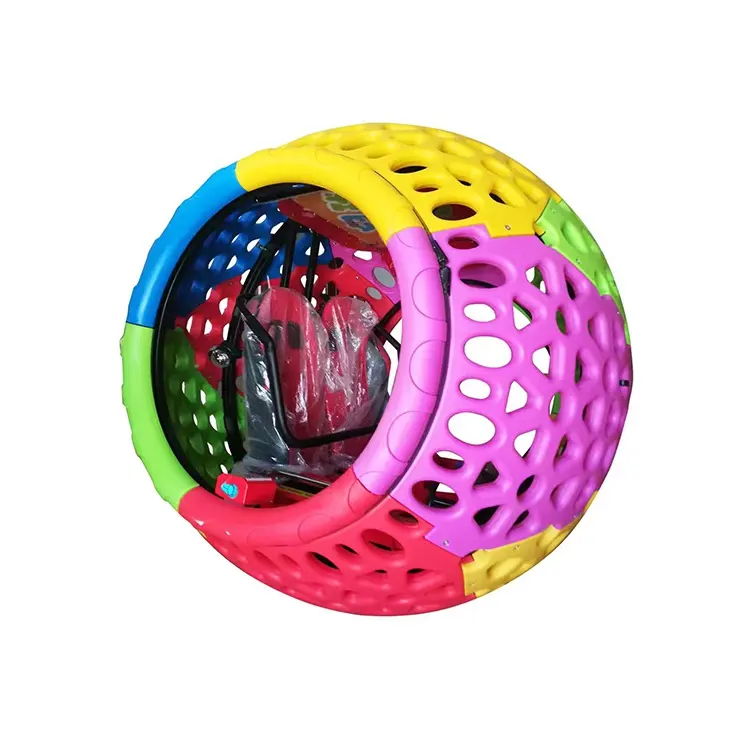
Marwey 360 Degree Remote Control Rolling Car Ride Wholesale Swinging Hamster Ball Manufacturer
Add excitement to your venue with the 360 Rolling Car Swinging Hamster Ball. A thrilling attraction for amusement parks and family entertainment centers.
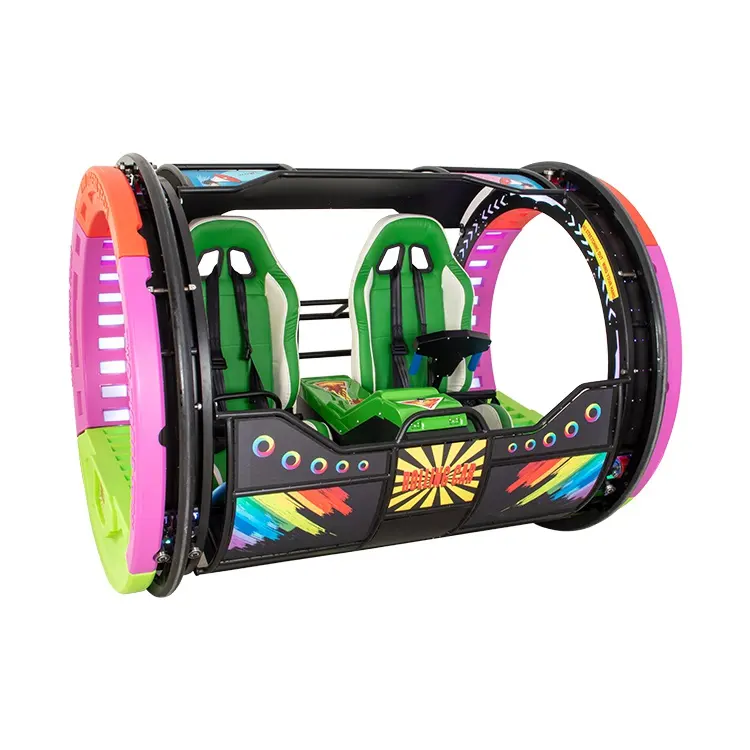
360 Degree Rolling Car for Adults Space Walker 360 Rolling Car Ride for Sale Marwey Amusement Equipment
Explore Marwey’s 360 Rolling Car ride, a thrilling amusement attraction for theme parks and FECs. Durable design, smooth rotation, and customizable solutions.
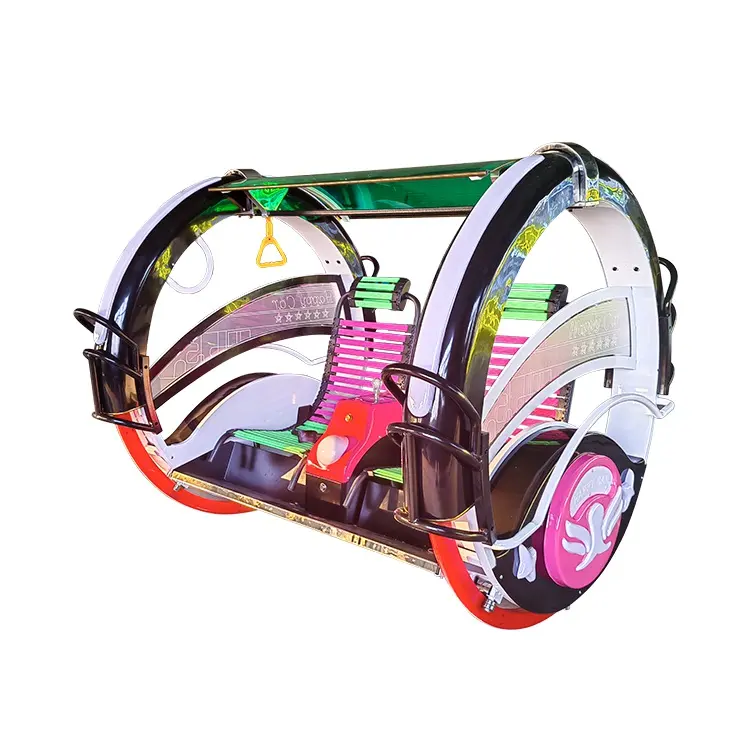
Marwey 180 Degree Rolling Car for Sale 2 Seater Happy Roller Car Supplier
Discover the 180 Happy Rolling Car, an exciting spinning amusement ride for theme parks and family entertainment centers. Safe, durable, and customizable by Marwey.
 Scan QR Code